Understanding Intrinsic Safety Markings for Oil & Gas, Petrochemicals & Utilities

Bodytrak 1 IS is one of the very few intrinsically safe solutions available globally to mitigate workplace risks and prevent incidents related to heat stress, fatigue and noise exposure. Committed to providing innovative solutions designed to protect employees and reduce the number of workplace fatalities, Bodytrak 1 IS has been designed to withstand some of the most hazardous and challenging conditions. Where the risks are often heightened in sectors such as oil and gas, petrochemicals and utilities, this smart safety solution complements existing personal protective equipment (PPE) to keep workers safe.
To better understand the importance of intrinsic safety product markings this guide dives into the details, empowering organisations to make informed decisions about equipment selection and utility within hazardous environments.
What are intrinsic safety product markings?
Working in hazardous environments requires meticulous attention to detail, particularly regarding equipment selection. Products entering potentially explosive atmospheres are required to be intrinsically safe, essentially ensuring that the ignition of explosive atmospheres is not possible. Intrinsic safety markings signify that the equipment complies with rigorous safety standards, determined through stringent testing and product approval procedures outlined by international regulatory bodies. By adhering to these markings, organisations ensure employee and plant safety so workers can focus on what they do best.
How to decode intrinsic safety markings
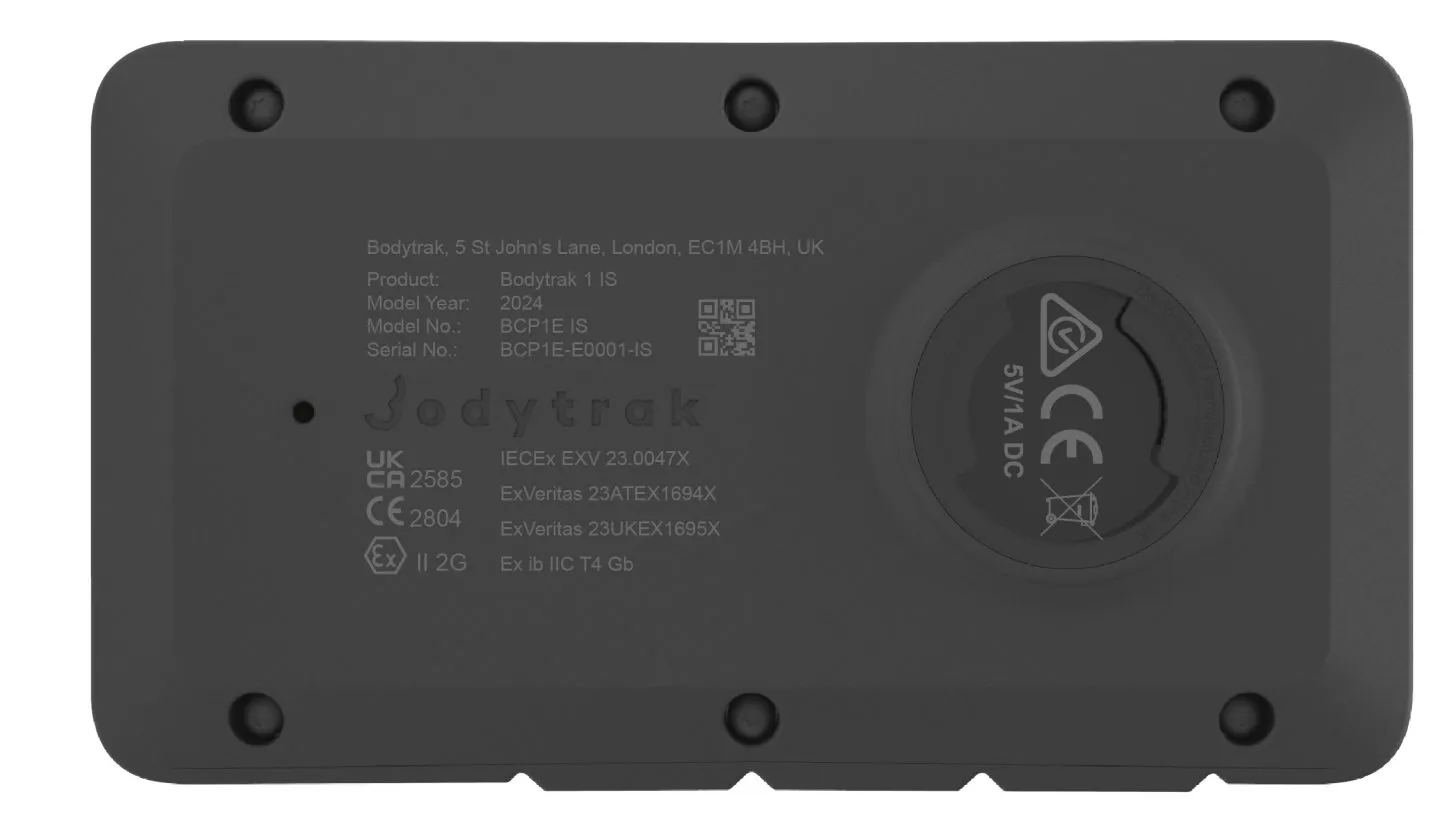

Intrinsic safety markings typically follow a standardised format, often including:
Marking authority
This identifies the region that the equipment has been certified for use within, such as ATEX (Europe), IECEx (international), UKEX (UK) or NEC and CEC (North America and Canada). It indicates the type of hazardous atmosphere the equipment is certified for. For ATEX this is represented by the Ex symbol or logo.
On the Bodytrak 1 IS device the Ex logo shows this is the ATEX certification.

Roman numeral (I or II)
This represents device group. ‘I’ indicates the device is certified for mining in hazardous environments below ground, while ‘II’ includes all other areas except for mining.
For Bodytrak 1 IS, category II signifies the device is for gaseous environments, other than below ground mining.

Numerical figure (1, 2 or 3) and letter (G or D)
The number refers to the likelihood of gases being present under normal conditions, divided into three categories, whereas the letter (either G or D) highlights the type of explosive substance: G for gas, steam and mist and D for dust, fibres and lint. When explosive atmospheres are continuous or present for long periods this is represented by 1 (high). Imagine a fuel tank or a pipe carrying petrol underground, in these areas petrol vapours are constantly present, creating a high risk of explosion and therefore fall under category 1. Now consider the area around a petrol pump nozzle when fuel is being put into a vehicle. While petrol vapour isn’t always there, it’s likely to occur when filling the tank, creating a medium risk of explosion. This is categorised by 2 (medium). Finally, category 3 is the lowest. Using the same example of a petrol station, this would be the parking area away from the pumps. Within this area petrol vapour is unlikely to be present under normal operation, making the explosion risk low.
2G for Bodytrak 1 IS indicates the device is certified in environments that are of medium risk of explosion and can withstand gas, steam and mist.

‘i’ followed by a lowercase letter (a, b or c)
This identifies the type of protection and the level of protection for the enclosure. (ia) is the highest level of intrinsic safety. This is designed for use in the most hazardous environments with the highest risk of ignition, also known as zone 0. These are areas where there is a constant presence of flammable gas, vapour, or mist in the air such as inside flammable liquid storage tanks or pits containing flammable materials. (ib) represents a moderate level for intrinsic safety, suitable for zone 1 hazardous areas. These are locations where an explosive atmosphere consisting of flammable gas, vapour, or mist is less likely to occur in normal operation. The lowest level of intrinsic safety is (ic), applicable for zone 2, which is for use in less hazardous environments where the risk of ignition is unlikely to be present in normal operation but may occur occasionally under abnormal conditions.
Bodytrak 1 IS is certified with ‘ib’ as it is considered intrinsically safe for operation in environments with a moderate risk of ignition. This means it’s designed to be incapable of generating sparks or excessive heat even under a single fault condition. The Bodytrak solution is a wearable device, so it should only be entering areas that the human body can withstand and the need for a higher level of protection is not usually required.

Roman numeral (I, II or III) and letter (C, B or A)
This refers to the explosive gas group the device is certified for. IIA covers propane, methane, gasoline. IIB includes hydrogen, sulphide and ethylene. IIC covers the most explosive with hydrogen and acetylene.
Bodytrak 1 IS has been certified with IIC which makes it safe for use with all gas groups (IIC, IIB, and IIA) because it can operate with the most sensitive gas mixtures.

T followed by a number (1 to 6)
This indicates the maximum surface temperature the equipment can reach without igniting the surrounding atmosphere. This scale ranges from T6 (less than or equal to 85°C) through to T1 (less than or equal to 450°C).
This is an extremely important factor to consider when placing any device near flammable materials. Bodytrak 1 IS is categorised with T4 indicating the maximum surface temperature of 135°C. This rating is suitable for use in environments with flammable materials that have an autoignition temperature above 135°C. Most industrial gases, except for some rare exceptions like carbon disulphide, fall into this category.

Capital letter (M, G or D) followed by a lowercase letter (a, b or c)
This identifies the explosion protection level. Certifications with M cover mines, G is for gas and D represents dust. The letter after this highlights whether the protection level is very high (a), high (b) or enhanced (c).
Bodytrak 1 IS is certified with Gb. This signifies that it is certified for use in areas where the risk of explosions as a result of flammable gases, vapours, or mists are high. This means it can be used in zone 1 and 2 – where an explosive atmosphere is unlikely to be present in normal operation but may occur occasionally under abnormal conditions.

What are the benefits of using intrinsically safe equipment
In certain environments, such as those described here, it is mandatory to use intrinsically safe equipment. It’s extremely important to ensure that both users and organisations always review the user manual and hazardous area classification documents supplied by the equipment provider to ensure correct selection and operation within the specific environment. By selecting the right equipment, organisations can leverage the many benefits and be legally compliant.
Mitigating the risks of explosions
Intrinsically safe equipment plays a vital role in safeguarding workers within hazardous environments, particularly those in oil and gas, petrochemicals and utilities. These industries often involve processes that handle flammable materials, creating a constant risk of explosion. Traditional equipment can generate sparks or heat, posing a significant threat of ignition in these explosive atmospheres. Equipment that is certified undergoes rigorous testing and certification to ensure it operates within safe parameters, minimising the risk of igniting flammable gases, vapours, or mists. This significantly reduces the potential for explosions and fires and subsequent injuries or fatalities.
Prioritising worker safety and peace of mind
By minimising explosion risks, intrinsically safe equipment directly enhances worker safety. It allows employees to perform their duties with greater confidence, knowing the equipment they use won’t inadvertently trigger an explosion. This peace of mind fosters a more focused and productive work environment. It provides confidence to employees that their organisation is equipped with safety at the forefront.
Complementing existing safety measures
Intrinsically safe equipment can work seamlessly with existing PPE to create a multi-layered safety approach. Bodytrak 1 IS, complements existing PPE by monitoring physiological responses and providing real-time alerts for potential heat stress, fatigue, or noise exposure. This comprehensive approach ensures worker wellbeing in even the most challenging environments, especially when wearing heavy PPE that can add greater physiological stress to the body.
Ensuring regulatory compliance
Regulatory bodies around the world have established stringent guidelines for equipment used in hazardous environments. These regulations aim to minimise the risk of explosions and subsequent worker injuries. Intrinsically safe equipment plays a vital role in achieving regulatory compliance. By undergoing rigorous testing and certification procedures, equipment like Bodytrak 1 IS demonstrates its adherence to these safety standards. This documented proof allows organisations to confidently operate within the legal framework, mitigating the risk of hefty fines or operational shutdowns due to non-compliance. Additionally, intrinsically safe equipment simplifies the auditing process for regulatory bodies, as the certification acts as a clear indicator of safety measures being in place.
Improved operational efficiency
Beyond worker safety and enhancing safety processes, intrinsically safe equipment can also contribute to improved operational efficiency. Traditional equipment, due to its potential for igniting hazardous atmospheres, often necessitates stricter operational protocols and limitations. These limitations can translate into reduced productivity, as work may need to be paused or relocated to safer zones. Intrinsically safe equipment, however, eliminates these concerns. With the reduced risk of explosions, operations can flow more efficiently, minimising downtime and delays. Now, with a smart safety solution like Bodytrak 1 IS, organisations can ensure their workers are focused at the tasks at hand and safeguarded against any extreme elements, mitigating the risk of incidents, which again minimises any downtime associated with workplace injuries.
Conclusion
Intrinsic safety markings serve as a vital indicator of equipment suitability for hazardous environments. By understanding these markings organisations are equipped with the right details to make informed choices for hazardous environments. In sectors such as oil and gas, petrochemicals and utilities, intrinsically safe solutions like Bodytrak 1 IS minimise explosion risks, fostering a safer and more productive workforce while also keeping users safe from other incidents. This translates to peace of mind for workers and operational efficiency through streamlined processes and reduced downtime. By prioritising safety and efficiency, intrinsically safe equipment empowers organisations to achieve a win-win for both employees and the bottom line.
Bodytrak® stands committed to providing innovative safety solutions to protect workers around the world and reduce the number of workplace incidents and fatalities. Bodytrak is proud to offer a smart safety solution that is intrinsically certified. This is a significant advancement for safety wearables. The ability to provide a safety solution for workers who face some of the most challenging and harsh environments, where the requirements for PPE are often higher and the risks greater, empowers organisations to make informed decisions that prioritise the wellbeing of staff and the integrity of the company’s operations.
For more information on Bodytrak 1 IS and how this comprehensive solution is revolutionising the approach to workplace safety, speak to the team today.